
Amsab-ISG
Bagattenstraat 174
9000 Gent
Tel: +32 (0)9 224 00 79
E-mail: info@amsab.be
Openingsuren
Bereikbaarheid
Bij Amsab-ISG werken we samen met een betrokken team van vrijwilligers, die een cruciale bijdrage leveren aan onze werking. Ze ondersteunen ons bij de waardering en verwerking van de collectie, werken mee aan onderzoek en helpen bij publieksactiviteiten.
Heb je interesse in sociaal geëngageerde bewegingen en het bewaren van hun erfgoed? Lees hieronder hoe je onze vrijwilligersploeg kan vervoegen.
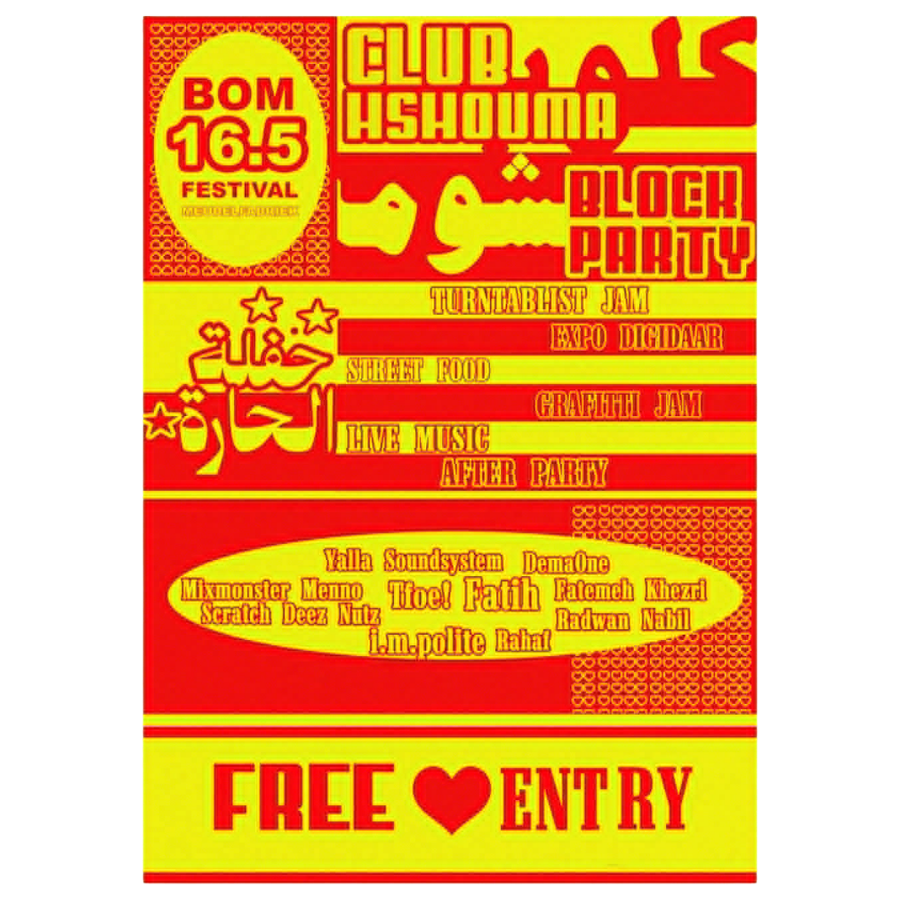
Saturday 16 May – From 15h
Meubelfabriek – Ghent
Digidaar celebrates two years of artistic work with a festive closing event at the Meubelfabriek, as part of Ghent’s BOMfestival. After a series of exhibitions in the virtual museum, you can now discover the work of artists in residence Fatemeh and Radwan in real life, or join DemaOne’s graffiti jam yourself. Meanwhile, Club Hshouma brings live music, street food and a turntablist jam.
(ON)BELICHT. Plaques de verre dans la collection d’Amsab-ISG
Les plaques de verre sont un terme générique désignant différents types de supports photographiques. Il s'agit notamment de négatifs sur verre pour le développement des photos, mais aussi, par exemple, des diapositives souvent utilisées pour projeter dans l’éducation.
Cette exposition vous présente une sélection des plaques de verre provenant des différentes collections conservées à l'Amsab-ISG : celles des journaux Vooruit et Volksgazet (période après la Seconde Guerre mondiale) et du collectionneur privé Lateur (fin du 19e siècle - première moitié du 20e siècle).
Il y a quelques années, nous avons eu l'occasion de faire digitaliser nos plaques de verre, un processus que nous expliquons dans cette exposition.
Malgré la fragilité des plaques de verre, vous pouvez en admirer quelques-unes dans cette exposition. Elles restent en effet une source précieuse. Nous réfléchissons également à la place de la plaque de verre dans l'histoire de la photographie.
Vous en apprendrez davantage sur les défis de la collection de plaques de verre, à la fois le matériel et le contenu. Avant la digitalisation, les plaques de verre étaient difficiles à consulter en raison de leur fragilité, ce qui rendait souvent difficile l'identification de ce qui y était représenté. Les images digitalisées ouvrent des nouvelles perspectives, mais soulèvent également des nouvelles questions. En effet, le contexte manquant a des implications, notamment en matière de métadatation et des droits d'auteur. Mais là encore, de nouvelles possibilités s'offrent à nous.
LA PLAQUE DE VERRE DANS LES ARCHIVES
Comment les plaques de verre se retrouvent-elles dans un centre d'archives ? Amsab-ISG conserve une série d'objets historiques qui ont souvent été donnés avec des archives et en font partie intégrante. Des autocollants, badges et affiches, drapeaux et autres supports promotionnels, tels que porte-clés, capes de pluie, briquets, et même chocolats et bouteilles de vin. Les plaques de verre en font également partie. Chaque objet se distingue par son matériau, sa forme et son format, et nécessite une approche spécifique en matière de conservation.
Aujourd'hui, la collection des plaques de verre de l'Amsab-ISG compte un peu plus de 10 000 pièces. Pendant longtemps, elles ont été conservées dans les boîtes d'origine dans lesquelles elles ont été reçues. Ces boîtes en ont aussi une valeur patrimoniale.
[Saviez-vous que les archives, les musées et les bibliothèques ne pas seulement conservées des collections, mais qu'ils les rendent également accessibles? Cela signifie que les dossiers, photos, publications et objets... sont soigneusement décrits dans un catalogue, selon certaines normes. Ainsi, tout est rendu accessible, facile à trouver et interchangeable pour ceux qui souhaitent recherché la collection.]
L'un des défis liés aux plaques de verre est que la majeure partie de la collection se compose de négatifs sur verre. Pour voir l'image, il faut placer la plaque de verre devant une source lumineuse. De plus, ce sont des objets fragiles, et leur nombre important rend leur accès difficile, ce qui demande beaucoup de temps et de moyens.
Le projet de digitalisation mené par meemoo [Institut flamand des archives] nous a donc semblé une excellente idée. Cela nous a permis d'accéder non seulement aux impressions digitales des plaques de verre elles-mêmes, mais aussi aux images positives dans une nouvelle base d'images. Mais cela n'a pas été sans mal.
EMBALLAGE
Pour leur digitalisation, mais aussi pour leur conservation, les plaques de verre ne pouvaient plus être conservées dans leurs boîtes d'origine. C'est pourquoi chaque plaque de verre a été réemballée : d'abord dans une ‘four flap’ [une enveloppe à quatre rabats qui se plie autour de la plaque de verre], puis dans une boîte d’archives non acides adaptée à son format.
[Saviez-vous que les documents d'archives, qu'ils soient en papier ou dans d'autres matériaux, doivent de préférence être conservés dans des boîtes d’archives non acides? Celles-ci offrent de meilleures conditions de conservation, même si leur durée de vie est également limitée.]
ENREGISTRER
Afin de pouvoir retrouver facilement les plaques de verre dans la base d'images, chacune d'entre elles devait être enregistrée séparément. Chaque plaque de verre a d'abord reçu un code-barres unique, qui permet de conserver le lien entre la plaque de verre physique et les images digitales.
En outre, il fallait également enregistrer autant d'informations que possible sur chaque plaque de verre. Il ne s'agissait pas seulement du contenu de l'image, mais aussi d'une description technique du matériau.
Les plaques de verre existent en effet sous différentes formes et tailles. Certaines sont négatives, d'autres positives. Les diapositives étaient souvent étiquetées. De plus, le temps a causé des dommages, tels que des émulsions qui se détachent, des bris de verre, des rayures, une décoloration ou même de la moisissure.
[Vous souhaitez en savoir plus ? Toutes ces caractéristiques matérielles ont donc constitué de véritables défis pour la digitalisation. Dans la vidéo à la fin de l'exposition, Axelle de meemoo explique comment ces défis ont été relevés].
[Saviez-vous que l'attribution de données relatives au contenu, aux caractéristiques matérielles et autres est appelée ‘métadonnées’? Les métadonnées permettent donc l'accès et la consultation des archives.]
DIGITALISATION
La digitalisation des plaques de verre a été un véritable tour de force. Chaque plaque de verre a été photographiée séparément. Les négatifs devaient être exposés par le bas, tandis que les positifs et les plaques de verre étiquetées étaient également éclairés par le haut. La plaque de verre était placée perpendiculairement, côté émulsion vers le haut, à distance sous l'objectif. Ce n'est qu'ensuite que l'image pouvait être capturée.
[Vous souhaitez en savoir plus ? Le site web totindetail.be vous informe en détail sur les différents projets de numérisation de meemoo. Pour ceux qui préfèrent écouter plutôt que lire, il existe également un podcast !]
LA PLAQUE DE VERRE DANS LA COLLECTION DE L'AMSAB-ISG
Mais que représente exactement ces plus de 10 000 plaques de verre ? Grâce à la digitalisation, vous avez pour la première fois la possibilité de voir les images de près.
L'unité de notre collection dans la base d'images repose exclusivement sur leur uniformité matérielle. Sur le plan du contenu, il s'agit d'une grande variété des photos dans le domaine plus large de l'histoire sociale. Cette diversité découle en outre du fait qu'elles proviennent de différentes collections d'archives. Dans cette exposition, nous nous concentrons sur les deux plus importantes.
La plus ancienne est la collection Lateur, du nom du collectionneur qui en a fait don. Lateur a probablement acheté une grande partie des plaques de verre provenant de collections privées dans des brocantes. Nous ne savons donc pratiquement rien du photographe ni des personnes figurant sur les photos. L'autre sous-collection est celle des journaux Vooruit et Volksgazet. Ces photos ont une approche très différente, mais ont également perdu une grande partie du contexte original dans lequel elles ont été prises.
Ces deux collections partielles témoignent néanmoins d'une époque spécifique, chacune avec ses propres complexités et défis. Elles soulèvent ainsi toutes deux des questions relatives au droit d'auteur et, par extension, au droit à l'image.
[Saviez-vous que tant que vous êtes en vie, et jusqu'à 70 ans après votre décès, votre œuvre artistique est protégée par le droit d'auteur ? Si, par exemple, vous réalisez une peinture et que quelqu'un publie cette peinture dans un livre, cette personne doit obtenir votre autorisation et vous pouvez également demander une compensation financière. Après votre décès, vos héritiers doivent être contactés. Le droit à l'image, en revanche, stipule que vous devez demander l'autorisation d'une personne lorsque vous diffusez (ou redistribuez) une image de cette personne.]
COLLECTION LATEUR
Cette collection couvre la période allant de la fin du 19e siècle à la première moitié du 20e siècle. À cette époque, les photos étaient principalement prises par et pour les classes supérieures de la société. Elles offrent néanmoins un aperçu de cette période, ce qui leur confère sans aucun doute une grande valeur historique.
Cette sous-collection est arrivée dans nos archives comme un tout, mais ce n'est en réalité pas le cas. Elle a été donnée par une seule personne, mais elle couvre des dizaines de vies (inconnues). Le contexte a souvent été complètement perdu, ce qui soulève plus de questions que de réponses. En outre, des questions éthiques se posent également : ces personnes souhaitaient-elles que leurs photos soient conservées dans des archives ? Et acceptaient-elles d'être immortalisées sur ces clichés ? Nous souhaitons néanmoins montrer ces images. En tant que source historique, mais aussi simplement comme témoins d'une époque révolue.
REGARDER À L'INTÉRIEUR
Tout d'abord, nous regardons à l'intérieur en tant qu'observateurs extérieurs. Nous voyons des images intimes de personnes dans leur propre espace, en interaction les unes avec les autres. Un aperçu des maisons, des intérieurs, de la mode, des moyens de transport et des loisirs de cette période.
LE MONDE À L'EXTÉRIEUR
Les photos de vacances ou la rue au coin de la rue ont été immortalisées. Et même les travailleurs n'ont pas échappé à l'objectif.
FRANS ET MARIA
Nous n'avons guère plus que leurs noms et quelques dates ici et là. Les photos peuvent être datées entre 1922 et 1946 environ. La série montre un aperçu de la vie de Frans et Maria. Ils posent, séparément et ensemble, de manière ludique, parfois très intime, avec des amis et de la famille. Nous faisons ainsi la connaissance de ‘Oncle Prosper’ ou ‘Père’. Et avec des amis comme ‘Nant’ et ‘Gerarda’. Des noms de lieux tels que ‘St. Anna[bos]’ et ‘Merxem’ apparaissent dans les descriptions, ainsi qu'un restaurant appelé ‘Lekkerbek’, qui se trouvait autrefois à Waasmunster. Il y a donc de fortes chances qu'ils soient originaires d'Anvers ou des environs.
Frans faisait probablement partie d'un cercle photographique. C'est ce que nous déduisons des nombreuses photos posées. Cela explique peut-être aussi pourquoi nous disposons d'autant d'informations sur cette série. Les négatifs sur verre ont été soigneusement conservés dans des enveloppes, chacune accompagnée d'une description. Frans et Maria ont ainsi constitué leur propre archive photographique.
GABY LOGELAIN
Une découverte tout à fait fortuite, mais qui a immédiatement attiré l'attention : une sculpture représentant une jeune fille posant avec un dessin à la craie, signée ‘Gaby Logelain’ et datée de ‘1925’.
Après quelques recherches, nous osons affirmer que Gaby pourrait bien être la fille du peintre Henri Logelain.
La deuxième fille d'Henri et de sa femme, née en 1916, s'appelait en effet Gaby. Une œuvre d'Henri Logelain datant de 1934 porte d'ailleurs le titre ‘Bietje, mijn dochter’ (Bietje, ma fille). En y regardant de plus près, on constate des similitudes évidentes entre Gaby sur la photo et la femme sur le tableau.
JOURNAUX
Au total, nous conservons à l'Amsab-ISG environ un demi-million de photos des journaux Vooruit (éditeur sm Het Licht) et Volksgazet, ainsi que, depuis 1978, de leur successeur De Morgen. Cela comprend également les plaques de verre. Il s'agit principalement de négatifs sur verre, soit environ 5 250 photos.
Le contraste avec la collection privée de Lateur est grand. Les plaques de verre de la collection de journaux datent d'une période plus récente, principalement des années 1950-1960. Les images étaient destinées à un large public et ont été réalisées par des photographes professionnels. La collection de négatifs sur verre comprend exclusivement des reportages photographiques nationaux réalisés par les photographes au service des journaux. Pour les images étrangères, on faisait appel à des agences de presse.
Les photos étaient destinées à illustrer les articles du journal. C'est pourquoi nous les présentons, dans la mesure du possible, dans le contexte pour lequel elles ont été initialement réalisées. En associant les plaques de verre aux articles dans lesquels elles sont apparues, nous pouvons découvrir les histoires qui se cachent derrière les images.
Que trouvait-on dans les journaux dans les années 1950-1960 ? Dans les grandes lignes, les journaux comportaient alors les mêmes rubriques qu'aujourd'hui. Il y avait l'actualité en première page, l'actualité nationale et internationale, et bien sûr le sport. Mais des sujets plus légers étaient également abordés. Ainsi, un horoscope ou une bande dessinée était régulièrement publié, et les lecteurs recevaient des recommandations pour des sorties culturelles dans la rubrique ‘Où aller aujourd'hui’. Certaines pages étaient en outre remplies de publicités pour des poudres, des produits alimentaires, des vêtements et les dernières nouveautés technologiques.
Les journaux de l'époque ne sont toutefois pas comparables à ceux d'aujourd'hui. Les produits étaient souvent en vente dans les magasins coopératifs de Vooruit. Pendant les élections, seules les campagnes du BSP [l'ancien parti socialiste en Flandre] bénéficiaient d'une visibilité, et une grande partie de l'actualité consistait en des reportages sur les syndicats et les associations socialistes, telles que les harmonies et les maisons du peuple.
À l'époque, la société était encore très cloisonnée. Les journaux étaient donc beaucoup plus politisés, ce qui se reflétait dans les articles et, par extension, dans les photos.
CE QUE NOUS N'AVONS PAS TROUVÉ
Pour être honnêtes, nous devons admettre qu'il était plutôt exceptionnel que nous puissions établir un lien entre une photo et l'article de journal correspondant.
Une fois qu'une photo était parue dans le journal, le négatif était rangé dans une armoire. Ici et là, nous pouvons lire sur la boîte d'origine une date, un lieu, parfois un événement, mais il n'y a pas beaucoup plus. À partir de ces données, nous avons parfois réussi à faire le lien entre les deux, mais dans la grande majorité des cas, cela s'est avéré impossible. Le contexte a disparu et n'existe souvent plus que dans les journaux eux-mêmes.
ANCIENNES SOURCES – NOUVELLES TECHNOLOGIES
Le secteur du patrimoine explore aujourd'hui pleinement les possibilités offertes par l'intelligence artificielle (IA) pour décrire et rendre accessible le patrimoine. Amsab-ISG est également régulièrement partenaire de projets qui utilisent ces technologies.
Meemoo a ainsi lancé plusieurs projets visant à enrichir le patrimoine audiovisuel (vidéo et audio) avec des métadonnées basées sur l'IA. Ces projets font notamment appel à la reconnaissance vocale (conversion de la parole en texte consultable), à la reconnaissance des personnes, d'organisations et des lieux, ainsi qu'à la reconnaissance faciale dans les vidéos. Entre-temps, de nouvelles applications de l'IA sont également utilisées, telles que la reconnaissance vocale (qui parle ?), la classification audio (que s'entend-il ?) et la reconnaissance faciale sur les photos.
L'IA est également particulièrement adaptée aux collections dont le contexte a été (en partie) perdu, ou pour rendre accessibles des collections complexes et difficiles d'accès. Le projet Glashelder (Clair comme du cristal) de nos collègues de la Boekentoren Gent est un bel exemple. Ce projet examine comment les modèles de langage visuel existants et d'autres techniques d'IA peuvent être utilisés pour décrire leur collection d'images comprenant pas moins de 62 000 plaques de verre numérisés. Parallèlement, le projet aborde d'importantes questions éthiques et juridiques. Quel rôle reste-t-il par exemple à l'expertise humaine, et quand les descriptions de l'IA peuvent-elles être considérées comme fiables ?
À condition de faire preuve de la prudence nécessaire, l'IA pourra donc nous aider à l'avenir à mieux décrire et rendre accessibles de grandes quantités d'images, telles que nos 10 500 plaques de verre.
Savoir plus Hermesproject van meemoo?
Savoir plus Glashelder?
ENGLISH
(ON)BELICHT. Glasplaten in de collectie van Amsab-ISG
Glass plates is an umbrella term for various types of photographic media. These include glass negatives for developing photographs, but also slides that were often used for projection in classrooms.
This exhibition presents a selection of glass plates from various collections held by Amsab-ISG: those of the newspapers Vooruit and Volksgazet (post-World War II period), and those of the private collector Lateur (late 19th to first half of the 20th century). A few years ago, we had the opportunity to have our glass plates digitised, a process that we explore in this exhibition.
Despite the fragility of the physical glass plates, you can still admire some of them in this exhibition. They remain an invaluable source of information. We therefore reflect on the place of the glass plate in the history of photography.
You will also learn more about the challenges posed by the glass plate collection, both in terms of material and content. Before digitisation, the glass plates were difficult to consult due to their fragility, which often made it unclear what was depicted on them. The digital images open up new perspectives but also raise new questions. The often missing context has implications for metadata annotation and copyright, among other things. But this also offers new opportunities.
GLASS PLATES IN THE ARCHIVE OF AMSAB-ISG
How do glass plates end up in an archive institution? Amsab-ISG preserves a wide range of historical objects, most of which were donated to an archive and form part of it. From stickers, badges and posters to flags and all kinds of promotional material, such as key rings, rain caps, lighters, and even chocolates and wine bottles. Glass plates are also part of this collection. Each object differs in material, shape and size, and requires its own approach in terms of preservation.
Today, the collection of glass plates at Amsab-ISG numbers just over 10,000 items. For a long time, they were stored in the original boxes in which they were received. These boxes now also have heritage value.
[Did you know that archives, museums and libraries not only preserve collections, but also make them accessible? This means that files, photographs, publications and objects are carefully described in a catalogue, according to certain standards. This makes everything accessible, findable and exchangeable for anyone who wants to browse the collection.]
One of the challenges with glass plates is that the vast majority of the collection consists of glass negatives. To see the image, you have to place the glass plate in front of a light source. Moreover, they are fragile objects, and their large number makes accessing them a labour-intensive process that requires time and resources.
The digitisation project led by meemoo [Flemish Institute for the Archive] was therefore music to our ears. It gave us access not only to digital prints of the glass plates themselves, but also to the positive images in a new image database. However, this was preceded by a lengthy process.
PACKAGING
For digitisation purposes, but also for their continued preservation, the glass plates could no longer be stored in their original boxes. Each glass plate was therefore repackaged: first in a “four flap” [an envelope with four flaps that are folded around the glass plate] and then in an acid-free box according to size.
[Did you know that archive documents, whether made of paper or other materials, are preferably stored in acid-free boxes? These provide better storage conditions, although even these boxes have an expiration date.]
REGISTRATION
In order to be able to quickly retrieve the glass plates from the image database, each one had to be registered individually. Each glass plate was first given a unique barcode, which ensures that the link between the physical glass plate and the digital images is maintained.
In addition, as much information as possible about each glass plate had to be recorded. This included not only the content of the image, but also a technical description of the material.
Glass plates come in various shapes and sizes. Some are negatives, others positives. Slides were often labelled. Furthermore, over time some became damaged, such as emulsion detachment, glass breakage, scratches, discolouration or even mould.
[Want to know more? All these material characteristics posed real challenges for digitisation. In the video at the end of the exhibition, Axelle from meemoo explains how these challenges were addressed].
[Did you know that assigning content, material and other data is called “metadata annotation”? Metadata annotation therefore makes it possible to access and consult archives.]
DIGITISATION
Digitising glass plates is not an easy task. Each glass plate was photographed separately. Negatives had to be exposed from below, while positives and glass plates with labels were also exposed from above. The glass plate was placed perpendicular to the lens, with the emulsion side facing upwards, at a distance. Only then could the image be captured.
[Want to know more? The website totindetail.be tells you all about meemoo's various digitisation projects. For those who prefer listening to reading, there is also a podcast!]
DE GLASPLAAT IN DE COLLECTIE VAN AMSAB-ISG
But what exactly is depicted on these more than 10,000 glass plates? Thanks to digitisation, we now have the opportunity to view the images up close for the first time.
The unity of our collection in the image bank is based solely on their material uniformity. In terms of content, it comprises a wide variety of photographs within the broader field of social history. This diversity also stems from the fact that they come from different archive collections. In this exhibition, we focus on the two largest.
The oldest is the Lateur collection, named after the collector who donated it. Lateur probably bought many of the glass plates from private collections at flea markets. As a result, we know very little to nothing about the photographer or the people in the photographs. The other subcollection is that of the newspapers Vooruit and Volksgazet. These photographs have a completely different approach but have also lost much of the original context in which they were taken.
Nevertheless, both subcollections bear witness to a specific era, each with its own complexities and challenges. For example, they both raise questions about copyright and, by extension, portrait rights.
[Did you know that your artistic work is protected by copyright for as long as you live and for 70 years after your death? For example, if you create a painting and someone publishes that painting in a book, they must have your permission and you can also request compensation. After your death, your heirs must be contacted. Portrait rights, on the other hand, stipulate that you must ask a person's permission when you would further distribute an image of that person.]
LATEUR COLLECTION
This collection covers the period from the end of the 19th century to the first half of the 20th century. At that time, photographs were mainly taken by – and for – the upper echelons of society. Nevertheless, the images provide a snapshot of that period, which undoubtedly makes them historically valuable.
This subcollection entered our archive as a single entity, but in reality, it is not. It was donated by one person, but encompasses dozens of (unknown) lives. The context has often been completely lost, leaving more questions than answers. Ethical questions also arise: did these people want their photographs to end up in an archive? And did they agree to have their picture taken? Nevertheless, we want to display the images. As a historical source, but also as witnesses to a bygone era.
A LOOK INSIDE
First, we look inside as outsiders. We see intimate images of people in their own homes interacting with each other. A glimpse of the houses, interiors, fashion, means of transport and leisure activities of that period.
THE WORLD OUTSIDE
Holiday snaps or the street around the corner were also captured on camera. And even the working man could not escape the lens.
FRANS AND MARIA
We don't really get much more than their names and a few dates here and there. The photos can be dated between approximately 1922 and 1946. The series shows a glimpse of the lives of Frans and Maria. They pose, separately and together, playfully and sometimes very intimately, with friends and family. This is how we get to know “Uncle Prosper” or “Father”. And with friends such as “Nant” and “Gerarda”. Place names such as “St. Anna[bos]” and “Merxem” appear in the descriptions, as does a restaurant called “Lekkerbek”, which used to be in Waasmunster. It is therefore likely that they came from Antwerp or the surrounding area.
Frans was probably a member of a photography club. We can deduce this from the many posed photographs. And it may also explain why we have so much information about this series. The glass negatives were carefully stored in envelopes, each with a description. In this way, Frans and Maria created their own photo archive.
GABY LOGELAIN
A very chance discovery, but one that immediately caught our attention: a picture of a girl posing with a chalk drawing, signed “Gaby Logelain” and dated “1925”.
After some research, we dare to suggest that Gaby could well be the daughter of painter Henri Logelain.
The second daughter of Henri and his wife, born in 1916, was named Gaby. Moreover, a work by Henri Logelain from 1934 is titled “Bietje, mijn dochter” (Bietje, my daughter). If you look closely, you can see clear similarities between Gaby in the photo and the woman in the painting.
NEWSPAPERS
In total, we store around half a million photographs from the newspapers Vooruit (published by sm Het Licht) and Volksgazet at Amsab-ISG, and from 1978 onwards also from their successor De Morgen. This also includes the glass plates. These are mainly glass negatives, accounting for around 5,250 photographs.
These contrast sharply with the photographs of Lateur's private collection. The glass plates from the newspaper collection date from a later period, mainly the 1950s and 1960s. The images were intended for a wide audience and were taken by professional photographers. The collection of glass negatives consists exclusively of national photo reportages by the newspaper's own photographers. Press agencies were called upon to provide images from abroad.
The photographs were intended to illustrate the news articles. That is why, where possible, we also show them in the context for which they were originally created. By linking the glass plates to the articles in which they appeared, we can uncover the stories behind the images.
What did newspapers contain in the 1950s and 1960s? Broadly speaking, newspapers at that time contained the same sections as they do today. There was front page news, national and foreign affairs, and of course sports. But lighter topics were also covered. For example, there was a regular section for horoscopes or cartoons, and readers were given recommendations for cultural outings in the “Where to go today” section. Certain pages were filled with advertisements for powders, food, clothing and the latest technological gadgets.
Nevertheless, the newspapers of that time cannot be compared to those of today. The products advertised were often available in the Vooruit’s cooperative supermarkets. During elections, only campaigns by the BSP [the socialist party in Flanders at the time] were given visibility, and a large part of the news was about trade unions and socialist associations, such as harmonies and community centres.
After all, society was still very pillarised at the time. Newspapers were therefore much more politically biased, which was reflected in the reporting and, by extension, the photographs.
WHAT WE DIDN'T FIND
In all honesty, we have to admit that it was rather exceptional that we were able to link a photograph to the accompanying newspaper article.
After a photograph appeared in the newspaper, the negative was stored away in a cupboard. Here and there, we can read a date, a place, or perhaps an event on the original box, but in most cases, we don’t have anything. Based on the information we do have, we sometimes managed to match the two, but for the vast majority, it proved to be an impossible task. The context has disappeared and only exists in the newspapers themselves.
OLD SOURCES – NEW TECHNOLOGIES
Today, the heritage sector is actively exploring the possibilities of artificial intelligence (AI) for describing and completing public access of heritage. Amsab-ISG is a regular partner in projects that use these technologies.
For example, meemoo has launched a number of projects to enrich audiovisual heritage (video and audio) with metadata annotation based on AI. These projects use speech recognition (converting spoken language into searchable text), the recognition of people, organisations and places, and facial recognition in video, among other things. Meanwhile, newer AI applications are also being used, such as voice recognition (who is speaking?), audio classification (what can you hear?) and facial recognition in photographs.
AI is also particularly suitable for collections of which the context has been (partly) lost, or for completing public access of complex and difficult-to-access collections. A good example is the Glashelder project by our colleagues at the Boekentoren Gent. This project investigates how existing Visual Language Models and other AI techniques can be used to describe their image collection of around 62,000 digitised glass plates. At the same time, the project considers important ethical and legal questions. For example, what role remains for human expertise, and when can AI descriptions be considered reliable?
With necessary caution, AI could therefore help us in the future to better describe and make publicly accessible large amounts of visual material, such as our 10,500 glass plates.
Meer weten over Glashelder
Project 'Glashelder' | Boekentoren
Meer weten over het Hermesproject van meemoo
Hermes: encouraging media reuse | meemoo

Logo in pdf (pdf)
Wens je het logo vectorieel (ai, eps) of (png, jpg) dan neem je best contact op met

Studio Stone, or Atelier Stone, emerged from the photographic collaboration between the Belgian Wilhelmine Camille Honorine Schammelhout, known as Cami Stone, and the Russian Aleksander Serge Steinsapir, known as Sasha Stone, who were also a couple. They met in Berlin, where they established their studio in 1924. Although the name 'Stone' has faded somewhat into obscurity, they were among the leading photographers of their time.
In 1920, the vibrant world of photography found new forms of expression through the avant-garde movements Neues Sehen ('New Vision') and Neue Sachlichkeit ('New Objectivity') that had emerged in Germany. The Stones were fully part of this avant-garde, as were many of their acquaintances in Berlin, Paris, and Brussels. They were prominently featured in the major ‘modern’ photography exhibitions of their era, and their work appeared in numerous magazines and illustrated newspapers of the time.
In the early 1930s, the Stones left the German capital and moved to Brussels, where they opened a new studio. They continued to work there until their separation in 1939. Even afterwards, both continued to photograph: Sasha under the name 'Sasha Stone, art photographer' and Cami as 'Cami Schammelhout'.
Exploring the work of the Stones reveals a wide range of photographic subjects: architecture, urban planning, nudes, performance photography, artistic and political portraits, and social reportage. Both photographers devoted equal attention to these various areas. Their publications covered advertising, industrial and artistic photography, and portraits of children, all in equally high quality. After relocating to Brussels, they maintained the same approach and thematic focus in their work as in their Berlin period. This consistency is also reflected in the technical and aesthetic quality of their photographs, marked by the use of low or high angles, dynamic framing, sharp focus, and careful attention to light.
The Studio Stone exhibition is the result of a collaboration between the Musée de la Photographie in Charleroi and Amsab–Institute of Social History in Ghent. The full version of the exhibition was on view in Charleroi from 1 February to 18 May 2025. The Ghent edition is smaller in scale but focuses on highlights from the collection of Amsab-ISH, which includes more than 170 original prints, documents, and posters by the duo.
Photography is a powerful means of communication. It allows you to form a visual impression of a city or region. In the 1920s, a type of work emerged that focused on geographical areas (countries, regions, or cities), combining text and photographs. Studio Stone captured images of Berlin, Ghent, Paris, and Brussels. The photographs in the book Berlin in Bildern present both the old and the new Berlin, a city on the verge of change. Sasha used both classical images and photographs made according to the principles of New Photography. His images of Berlin – some of which were published in Berlin in Bildern – sometimes reflect a desire to portray the city as a modern metropolis. Emphasis is placed on the verticality of buildings through the use of the low-angle perspective, on city traffic as a symbol of urban modernity at the time, on electricity with images of the Klingenberg power plant, and on the construction of the underground, a symbol of progress.
Another form of architectural photography focuses on individual buildings or interior design. Studio Stone often did this work on commission, for instance for a magazine. In this type of photography, the emphasis is on the ‘exact’ transcription of reality. The photographer does not seek a particular angle or composition but aims for clear lines, objectivity, and a frontal view, highlighting spatial understanding and clarity on the materials used. Shadows and light are employed to emphasize the materials, for example, the different reflections of glass, wood, and stone. Industrial architecture is also captured in this way.
In addition to the ‘rationalised’ and ‘objective’ photographs of architecture, the Stones explored other ways of evoking the modernity of their time. They focused, for instance, on striking architectural details, such as the metal arch of a bridge, or on the technical elements of an installation. They did not hesitate to photograph buildings from bold angles. In the same spirit, they also created close-ups to produce 'still lifes' of everyday objects. Rather than offering an objective view, their images thus create a new perspective.
Photographs of performers on stage, backstage, and during rehearsals: the Stones—Sasha in particular—produced all kinds of 'show photography'. In Germany, director and founder of the proletarian theatre, Erwin Piscator, collaborated with Sasha Stone to photograph his new theatre. The photographer took countless images of actors during performances, rehearsals, and even of stage sets, all highlighting Piscator’s modern vision. His portraits of actresses and actors often share the same stylistic features: low-angle or high-angle shots, tight framing around the performers, dramatic lighting effects on stage, and frequently, an emphasized cast shadow.
In 1929–1930, the Stones made a large number of portraits of politicians, commissioned by the Belgian parliament. When they arrived in Belgium a few years later, they continued their political portraiture. They also photographed members of the Belgian Workers’ Party. These photos often share similar characteristics: a framing focused on the face and upper body revealing one shoulder, a slight low-angle perspective, a gaze rarely directed at the lens, and a neutral background. Some photos, however, are exceptions, such as the portrait of August Balthazar, a member of the Belgian socialist party, featuring a surprising close-up framing of the face.
Studio Stone often worked on commission, including for political parties. They created at least four posters for the Belgische Werkliedenpartij (BWP), the Belgian socialist party. These are compositions made from Studio Stone’s photographs, produced for elections or to celebrate the 50th anniversary of the BWP. The photos were originally taken in a different context and were often reused later for very different purposes.
The 1932 poster Moeders! Denkt aan onze toekomst! Stemt rood!(Mothers! Think of our future! Vote Red!) is a good example. In the lower right corner, there is a portrait of a girl, photographed in 1930 under the title Pulings Family. This photo later appeared again in the March 1936 issue of the magazine La Famille Prévoyante.
The photo series 5 minuten met Edward Anseele (5 Minutes with Edward Anseele) provides a visual report of the moment when Cami Stone showed the election poster design to Edward Anseele Sr., the leading figure of the BWP in Ghent.
The Stones extensively published their work in newspapers and illustrated magazines of the time. Their first photographs appeared in the German press from 1925 onwards. After their arrival in Brussels, Studio Stone’s photos were also featured in many Belgian magazines and newspapers, including La Famille Prévoyante.
Thanks to these numerous publications, Cami and Sasha Stone were not only among the most widely seen photographers of their time but also important promoters of the aesthetics of the New Photography.
As long as the studio was active, the Stones made portraits of celebrities of their time. Although they mainly moved in artistic circles, they also photographed political figures and even scientists. The portrait of Albert Einstein is the most striking example. Among those who posed for them were director Erwin Piscator, writer and playwright Bertolt Brecht, and actress Lucie Carow. These photos reveal the extensive network the Stones had. From a stylistic point of view, most portraits were taken from a slight low-angle perspective (with the camera placed below the subject, lens pointing upwards). The background is generally neutral or blurred, and the framing is tight around the face and shoulders.
Although there is no historical evidence of a clear political commitment by the Stones, their work shows a distinct preference for social themes. From their Berlin years and Sasha Stone’s strong ties to Erwin Piscator’s proletarian theater, to their Belgian decade marked by numerous photographs for the Belgian socialist party, the Stones often expressed a connection to socialist ideology. Many of their photos reflect the conventions of ‘leftist political photography’: an interest in ‘small trades,’ the depiction of social misery, and the heroic portrayal of the working-class figure. At the same time, Cami and Sasha Stone developed an interest in anecdotal, even picturesque images of everyday life.
June 27, 1892: Birth of Cami Stone, born Wilhelmine Camille Honorine Schammelhout, in Vilvoorde, Belgium.
December 16, 1895: Birth of Sasha Stone, born Aleksander Serge Steinsapir, in Saint Petersburg, Russia.
1911–1913: Sasha trains as an electrical mechanic in Warsaw.
1913: Sasha works in a small decorative ironwork company in New York under the name Alexander Stone, after having previously worked with sculptor Hunt Diederich.
1914–1918: World War I // Sasha takes his first photographs and is recruited as a co-pilot and aviation instructor for the British Army.
1916: The Dada intellectual and artistic movement is founded in Zurich under the leadership of Tristan Tzara.
Circa 1918: Sasha studies drawing and painting at a school in Bellevue near Paris, France. He establishes a small sculpture studio.
1918: Cami settles in New York, where she establishes an import-export company.
1918–1933: Rise of a new political regime in Germany known as the Weimar Republic.
1919: Walter Gropius founds the Bauhaus, a school of architecture and applied arts, in Weimar, Germany.
June–July 1920: First International Dada Fair in Berlin, with John Heartfield as the official photomontage artist.
Circa 1920: Emergence of the artistic movement New Objectivity, whose first official exhibition takes place in 1925 at the Kunsthalle in Mannheim, Germany.
Circa 1920: Emergence of the New Vision art movement, rooted in principles established by the Bauhaus.
Circa 1921: Sasha moves to Berlin and studies under sculptor Alexander Archipenko.
1924: Cami and Sasha Stone form a partnership and establish the Atelier Stone at 13 Kurfürstenstrasse in Berlin.
1924: They exhibit at the Große Berliner Kunstausstellung as part of the Novembergruppe section and at the Juryfreie Kunstschau in Berlin.
1925: László Moholy-Nagy publishes Painting. Photography. Film.
1925–1926: The Stones appear to work exclusively with the German publishing house Ullstein, which publishes titles such as Uhu, Die Dame, and Der Querschnitt.
1927: They move to a larger studio at 69 Kaiserin-Augusta-Strasse.
1928: Sasha exhibits at the 1st Independent Photography Salon in Paris alongside Berenice Abbott, Germaine Krull, André Kertész, Man Ray, and Eugène Atget.
1929: Man Ray and Lee Miller develop the photographic solarization process.
1929: Cami and Sasha take part in the exhibition Fotografie der Gegenwart in Essen and Berlin.
1929: They also participate, alongside Umbo, Heartfield, Lersky, and Moholy-Nagy, in the Internationale Ausstellung des Deutschen Werkbunds: Film und Foto (FiFo) in Stuttgart and Berlin.
1929: Werner Gräff publishes Es kommt der neue Fotograf! in conjunction with FiFo, outlining the core principles of photographic avant-garde.
1930: The Stones participate in three more exhibitions in Germany, including Das Lichtbild in Munich.
1931: German philosopher Walter Benjamin, a friend of Sasha Stone, publishes A Small History of Photography, in which he mentions Sasha Stone.
September 1931: They move from Berlin to Brussels. Between 1931 and 1939, they live at 18 rue de Naples (Cami’s family home), 278 avenue de la Couronne, and 43 chaussée de Charleroi.
July 1932: International Photography Exhibition at the Palace of Fine Arts in Brussels. Cami serves as secretary of the Belgian section with Victor Hennebert.
October 1932: They take part in the Fototentoonstelling in Ghent, alongside François Kollar and László Moholy-Nagy.
November 27, 1932: Belgian legislative elections. The Belgian Catholic Union wins, closely followed by the Belgian Labour Party. // The Stones design some of the election posters for the Belgian Labour Party.
January 1933: Adolf Hitler is appointed Chancellor of Germany.
June 1933: They exhibit the Nudes series at the Maison d’Art in Brussels.
June–July 1933: International Exhibition of Photography and Cinema at the Palace of Fine Arts in Brussels. The Stones present two 'photographic panels.'
May 24, 1936: Belgian legislative elections. The Belgian Labour Party wins.
Early 1939: Cami and Sasha separate, and the studio ceases activity.
1939: Cami marries José Stork, an employee of the Stone Studio.
1939: Sasha marries Lydia Edens, of Dutch origin.
1939–1945: World War II // During the war, Cami continues working as a freelance photographer.
May 1940: Due to his Jewish origins, Sasha flees the German advance with Lydia, their son Serge (born in 1939), and the studio secretary Michelline de Keuwer. They settle in Villelongue-de-la-Salanque near Perpignan, France. On August 6, 1940, Sasha dies of pulmonary tuberculosis at the hospital in Perpignan.
1940: Lydia Edens and Serge flee to the Netherlands.
1948: Cami opens a photography store called Photo Jeunesse in Brussels, selling and buying photographic equipment and 'art photography.' The store closes in the early 1950s.
March 3, 1975: Cami Stone passes away, having worked in the final years of her life as secretary of a medical-social service for foreigners in Belgium.
Klik gerust door om het museum te bezoeken, of bekijk onderaan het filmpje voor meer uitleg.
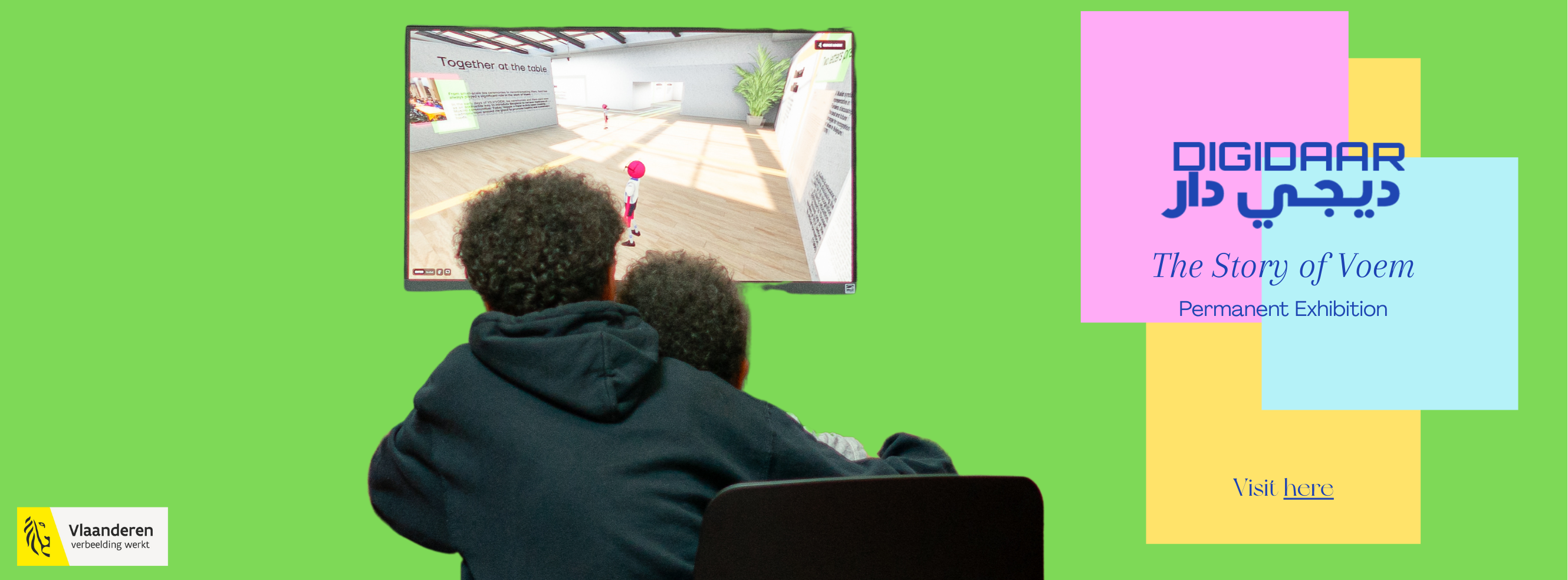
Ontdek de rijke geschiedenis van Voem: ooit ontstaan als een vereniging van 19 islamleerkrachten en vandaag een innovatieve kracht in het sociaal-cultureel veld.
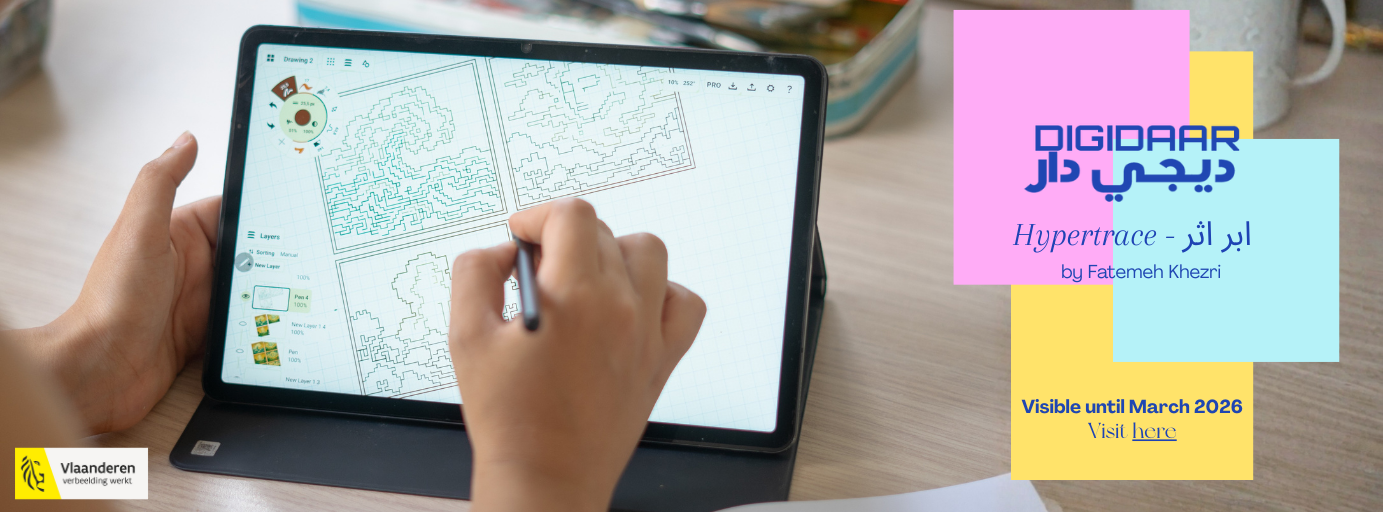
Voor de tentoonstelling HYPERTRACE - ابر اثر ging kunstenares Fatemeh Khezri aan de slag met het archief van Voem. Haar werken stelt ze voor als fragmenten van een geïmagineerde toekomst, gebaseerd op teksten, afbeeldingen, en gebeurtenissen uit het verleden van Voem.
De tentoonstelling biedt een poëtisch perspectief op erfgoed in het digitale tijdperk: het archief als niet enkel een bewaarplaats van het verleden, maar als een levende gids die ons de toekomst kan helpen verbeelden.
Bekijk het filmpje hieronder voor meer uitleg over het bezoeken van de tentoonstellingen.
Algemene vragen over Digidaar en het project errond? Bezoek dan zeker onze projectpagina.
Amsab-ISG
Bagattenstraat 174
9000 Gent
Tel: +32 (0)9 224 00 79
E-mail: info@amsab.be
Openingsuren
Bereikbaarheid